Search 470 million scientific articles. Every claim has a source.
Ask the scientific literature. Get answers with receipts.
These figures are the index. Page counts are in the atlas below.
See a cited answer, start to finish
Live demo of literature discovery, screening, and early extraction. Sources stay visible.
Not a summary — an argument with sources
Every answer is assembled from ranked records, not scraped web pages. Click any citation to open the paper, its authors, and the institutions behind it — all inside the Data Atlas.
See how it worksMostly yes for perceived recovery: cold-water immersion reliably reduces next-day soreness, while effects on objective performance are mixed. Post-strength-training immersion may blunt adaptation.
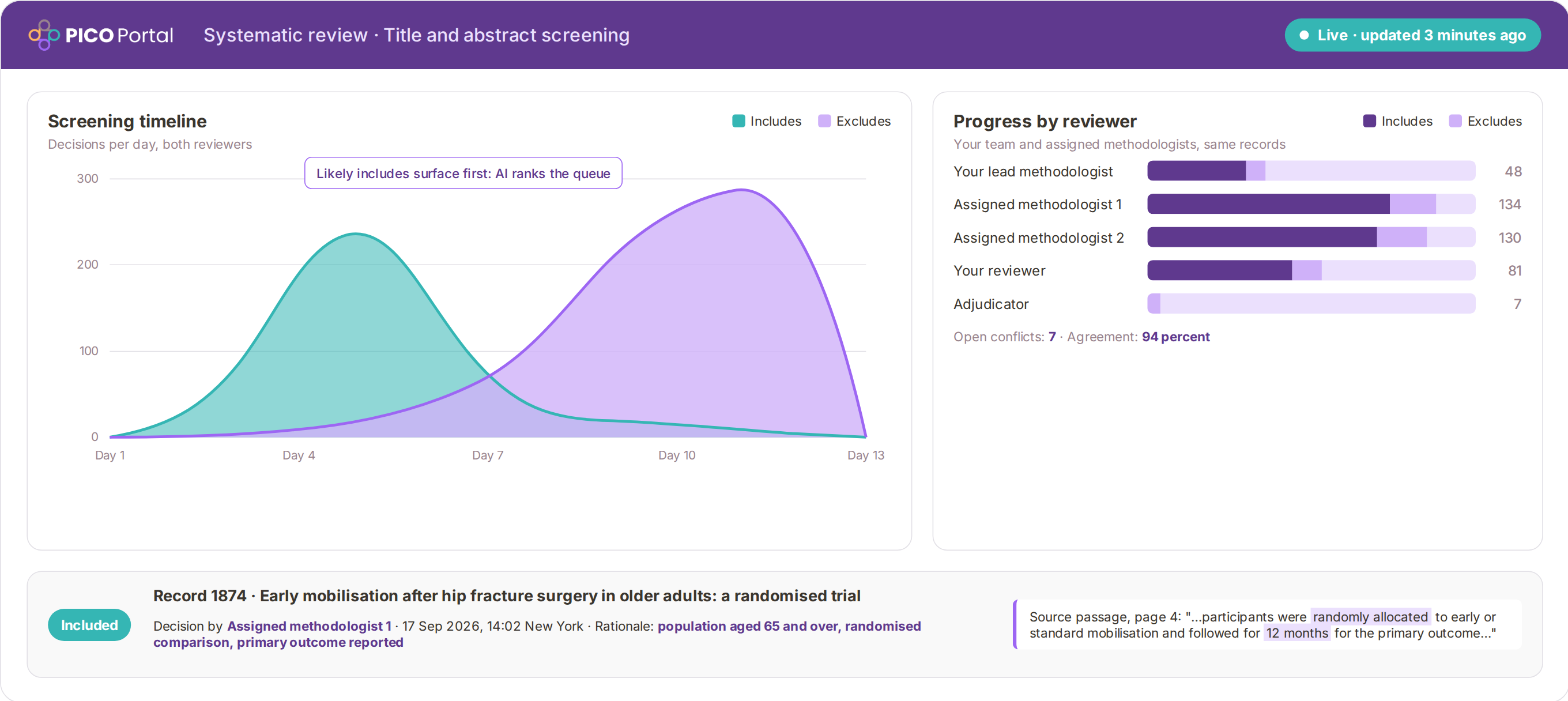
When someone questions an exclusion, can you show who decided, and on what passage?
Yes. The record has the named reviewer, the time, the rationale, and the source passage. ScholarIQ uses the same screening technology as PICO Portal. You make the call.
Queue, conflicts, pace, and agreement stay open while the stage is still open.
The rank, the passage, and the decision sit on the same record.
ScholarIQ does not make the include or exclude call.
- Search OpenAlex from a question, a citation, or a source document.
- Snowball from a seed paper to the papers that cite it, and to the papers it cites.
- Upload your records and review them next to the OpenAlex results.
- Rank records against your criteria. Highlight the passage. Suggest a value, each one linked to its source.
- Keep the decision record: named reviewer, time, rationale, source passage.
- The question, the criteria, and the outcome list.
- Include or exclude, with a rationale.
- The risk-of-bias judgment, on the instrument you name.
- What you write from the evidence.
Digital health evidence. 4,538 records. 1,330 screened. 193 studies included.
A review of digital decision-support tools in low- and middle-income countries ran in the team's workspace. Two reviewers screened the first 10 percent to calibrate. Ranking then ordered the rest. Screening stopped at an estimated 95 percent recall. The 3,208 lowest-ranked records were not screened. They were not exclusions.
PRISMA 2020 flow from the project record.
In an independent evaluation by Johns Hopkins researchers, this prioritization stopped title and abstract screening at an estimated 95 percent recall. It still found studies eligible at full text, with a sensitivity of 0.98 (95% CI 0.90 to 1.00).1
The KDIGO 2024 chronic kidney disease guideline screened its citations on this platform. It used the same prioritization and the same 95 percent recall stop.2
ScholarIQ sits on that platform. 11,182 verified users. 2,078 institutions. 116 countries.
1. Wilson LM, Robinson KA. Global Evidence Summit, Prague, 2024. Independent. Co-author Karen Robinson has a non-financial affiliation with PICO Portal. 2. KDIGO CKD Work Group. Kidney International. 2024;105(4S):S117–S314. doi:10.1016/j.kint.2023.10.018. Methods, Literature searches and article selection.
Questions
What is ScholarIQ?
ScholarIQ searches 470 million articles from OpenAlex, ORCID and PubMed. It answers in plain language. Every claim cites a source you can open.
How is ScholarIQ different from PubMed?
PubMed is a database. You search it with terms. ScholarIQ takes a question, ranks records, and returns an answer with citations. You can open each citation in the Data Atlas.
Does every answer include a source?
Yes. An answer is built from ranked records. Each claim links to the paper it came from.
Who makes the eligibility decisions?
You do. ScholarIQ ranks records and highlights passages. The record shows who decided, and why.
Where does the data sit?
In your workspace on the PICO Portal platform. Only the people you assign can open it. Your content is not used to train a model.